Vermont Resilience Planning Tool
Helping state agencies and municipalities understand climate risk, prioritize mitigation, and make uncertainty visible.
Some screens are simplified/anonymized to protect sensitive data.
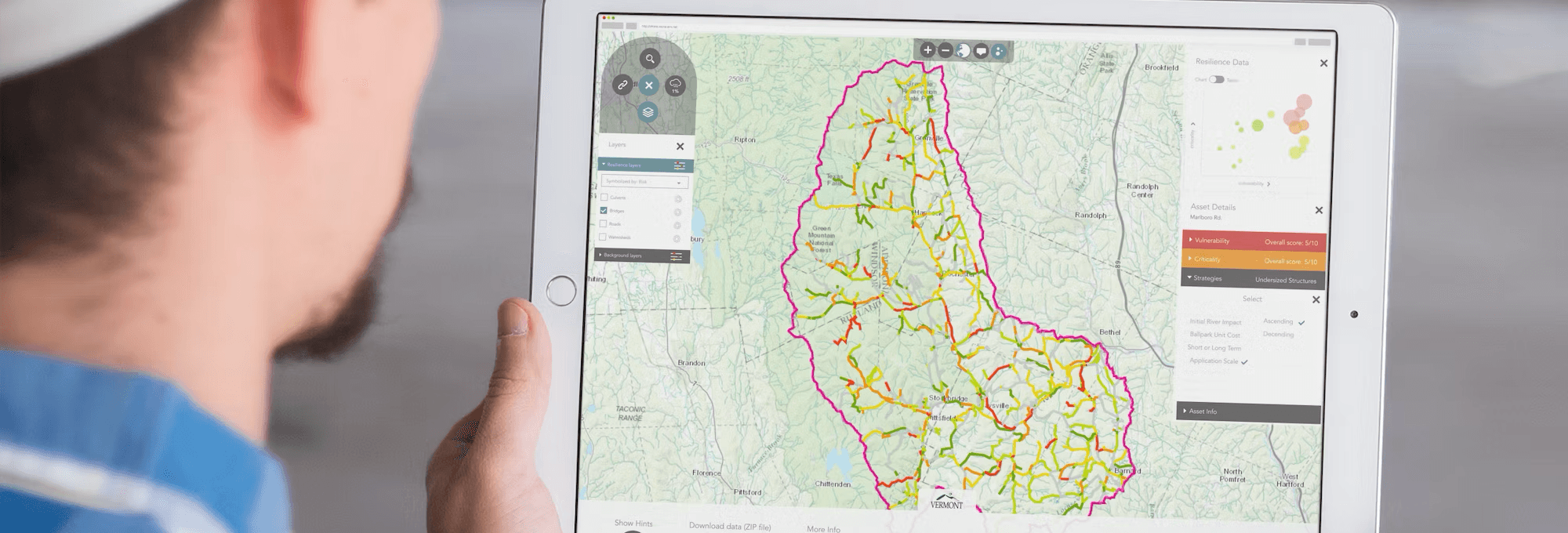
What this was
The Vermont Resilience Planning Tool was designed to help the Vermont Agency of Transportation and partner agencies understand climate vulnerability across the state.
It brought together flooding, erosion, infrastructure risk, and mitigation layers into a shared planning surface for prioritizing action under uncertainty.
This wasn’t a forecasting tool. It was a sensemaking tool.
Where people got stuck
- Fragmented data spread across maps, reports, and agencies
- High uncertainty with real-world consequences
- Difficulty explaining why one area should be prioritized over another
- Static outputs that didn’t support exploration or discussion
The problem wasn’t lack of data. It was lack of clarity, comparability, and confidence.
How I worked
I collaborated with researchers, engineers, and subject-matter experts to translate climate data into a usable planning experience.
- Interviews with planners and agency stakeholders
- Iterative prototyping of map interactions and overlays
- Testing how people interpreted scores, ranges, and uncertainty indicators
What changed
The tool evolved into an interactive system that supported exploration and discussion rather than prescribing answers.
- Layered map views that could be toggled intentionally
- Clear hierarchy between base geography and risk signals
- Aggregate vulnerability scores paired with transparent breakdowns
- Interactions that encouraged asking “why,” not just “what”
The goal wasn’t certainty. The goal was shared understanding.
What improved
- Faster alignment across agencies on risk priorities
- Clearer conversations about mitigation tradeoffs
- More confidence explaining decisions to stakeholders
- Less reliance on static reports and screenshots
The work shifted conversations from “What does the data say?” to “What should we do next?”
What I learned
Designing for climate resilience isn’t about perfect answers. It’s about supporting reasoning under uncertainty, making complexity navigable without oversimplifying, and treating ambiguity as a first-class constraint.
What I’d do with more time
- Expand scenario modeling and time-based comparisons
- Improve storytelling outputs for public communication
- Refine how uncertainty is visualized and explained
- Explore how the patterns could scale across agencies and states